
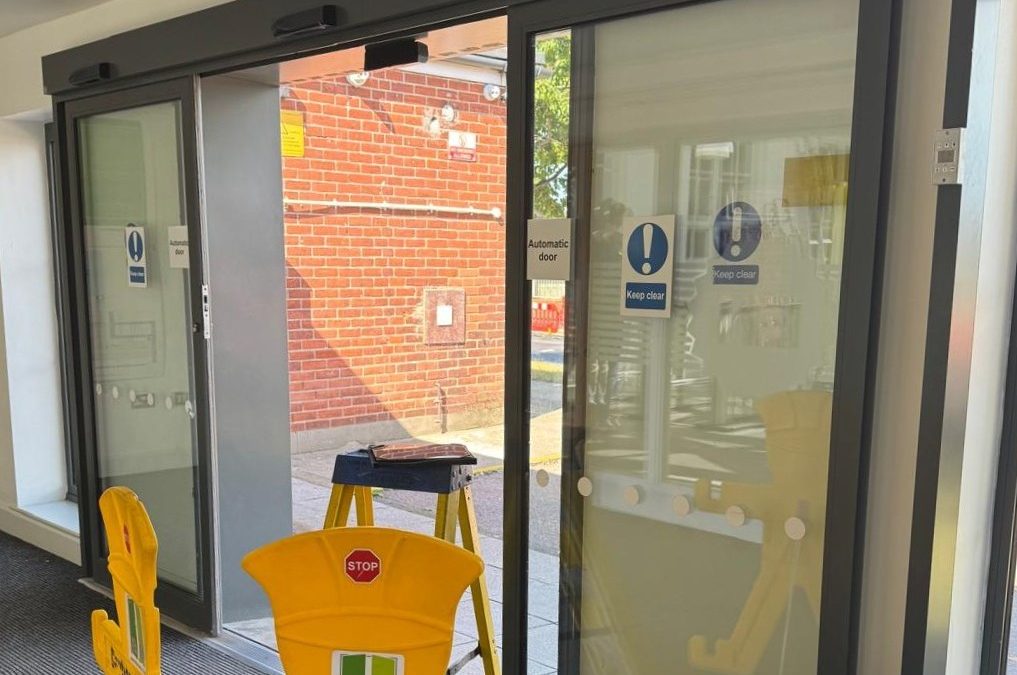
While power failures, worn rollers, or misadjusted controllers can all cause headaches, one category deserves special attention: safety sensors. These devices tell a door when to open, when to slow down, and—most importantly—when not to move because a person, trolley, buggy, or scooter is in the way.
Below, we’ll explain what safety sensors are, why they’re essential, how to recognize early warning signs, and practical steps you can take to test and maintain them for compliance and peace of mind.
Purpose of Door Safety Sensors
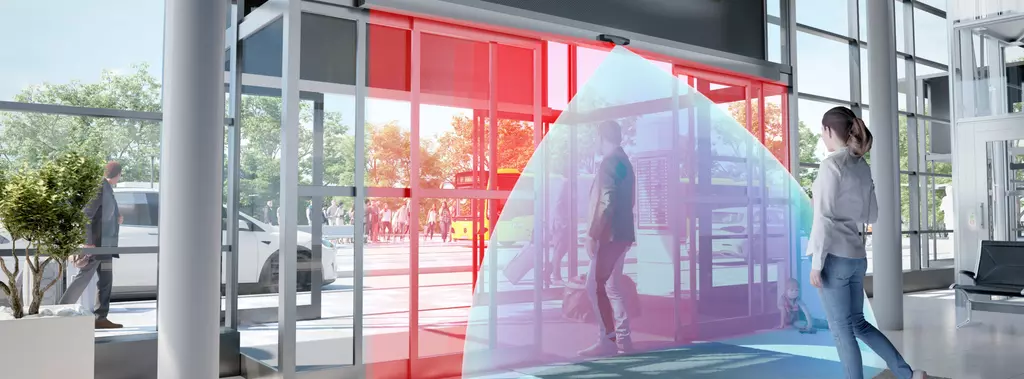
Automatic doors create fast, convenient access—but speed without situational awareness is dangerous. Safety sensors provide that awareness, continually watching the approach, threshold, and swing/slide path to prevent unwanted contact and entrapment. In short, sensors:
- Detect approaching traffic to activate a door at the right time.
- Create a presence zone to keep a door open while people or objects are in the path.
- Interrupt or reverse motion when someone enters the danger area mid-cycle.
- Adapt to changing environments—light, floor reflectivity, and movement—to stay reliable throughout the day.
When a sensor is clean, aligned, and correctly configured, customers enjoy seamless access, and you reduce liability exposure. When a sensor fails or drifts out of adjustment, the door may open late, “ghost” open, or close when it shouldn’t—each a safety and compliance risk.
British Safety Standards For commercial pedestrian doors in the United Kingdom, EN16005 / BS7036-0 standards define how doors should behave and how sensors contribute to a safe system. Two standards commonly referenced by facility managers and architects are:
- BS EN 16005 is a European standard (adopted in the UK as BS EN 16005) that sets safety requirements for power-operated pedestrian doors (sliding, swing, revolving, etc.), covering design, installation, and maintenance to prevent accidents by mitigating risks like crushing and shearing through features such as sensors, safety signage, and emergency provisions, ensuring safe use for all individuals, including vulnerable ones, and requiring regular upkeep by building owners.
- BS7036-0 is a British Standard code of practice (2014) focused on risk assessment and reduction for powered pedestrian doors (like automatic sliding or revolving doors), ensuring safety by guiding specifiers, installers, and owners to identify hazards and implement solutions, often in conjunction with European standards BS EN 16005 emphasizing features like “non-contact preferred routes” and safety devices to protect users from injury.
Staff should be trained to perform quick daily tests (more on that below) to catch issues before they become incidents.
Common Types of Safety Sensors
Understanding sensor types helps you diagnose problems efficiently and speak the same language as your service provider.
Here are the most common categories you’ll encounter on sliding, swinging, and revolving doors.

1) Approach (Activation) Sensors
What they do: Detect a person or cart approaching an entryway and signal the controller to open the door early enough to maintain a comfortable flow.
Where they are: Mounted above the door or on the header, typically aiming outward.
How they work:
- Microwave radar sensors detect motion using Doppler technology; great for speed and range, less sensitive to stationary objects.
- Active infrared (AIR) approach sensors emit and receive IR light, detecting motion and sometimes presence in a defined field.
Dual-technology units combine radar for activation with infrared for near-field presence, improving immunity to false triggers.
Common issues:
- Late opening (field set too small or angled too low).
- False triggers from moving foliage, busy streets, or reflective surfaces.
- Seasonal drift due to temperature, mounting vibration, or controller changes.
2) Presence (Safety) Sensors
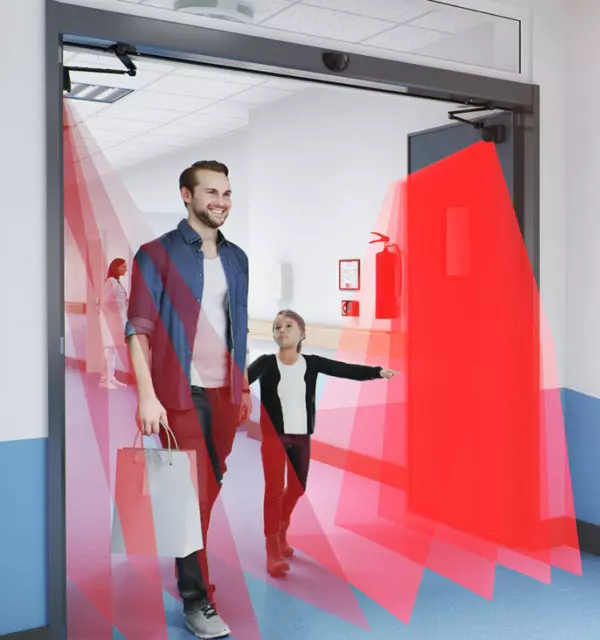
What they do: Create a safety zone in the door’s swing or slide path to keep it open while people or objects remain in harm’s way and to stop/reverse motion if someone enters the zone mid-cycle.
Where they are: On the header aiming downward, on the door leaf for swing paths, or built into the operator assembly for sliding doors.
How they work:
- Active infrared presence sensors project a matrix of beams or a “curtain” that recognizes stationary objects—strollers, mobility aids, luggage—as well as people who pause.
- More advanced units track detection density and compensate for floor reflectivity so dark rugs or shiny terrazzo don’t cause blind spots.
Common issues:
- Dead zones from dirt on the lens, mis-aimed brackets, or warped covers.
- Over-sensitivity keeps doors open too long, hurting energy performance.
- Under-sensitivity risks contact.
3) Touchless (Non-Contact) Actuators
What they do: Facilitate non-contact door openings via a wave-to-open gesture or proximity read—popularized during COVID-19 to reduce touchpoints.
Where they are: Wall-mounted near the approach zone or integrated into access control.
Common issues:
- Gesture distance set too short or too long.
- Ambient light false triggers if units aren’t filtered or mounted correctly.
- User confusion without clear signage or iconography.
Maintaining and Testing Sensors
A well-designed automatic door system is only as safe as its ongoing maintenance. Routine cleaning, functional checks, and documented tests are the backbone of compliance and longevity.
Daily Safety Check (2–3 Minutes)
Train opening staff to run a short checklist before business hours:
- Visual inspection – Confirm housings are secure, lenses are clean, and nothing obstructs the approach or swing path.
- Approach test – Walk toward the door at a normal pace from several angles. The door should open early enough for a comfortable pass without slowing or stopping.
- Presence hold-open – Stand motionless in the path; ensure the door remains open. Step out; the door should close after its programmed hold-open time.
- Interruption test – As the door begins to close, step into the safety zone; it should stop and reopen immediately.
- Signage and decals – Verify mandated decals (“Automatic Door,” “Activate to Open”, “Keep Clear”) are present and readable.
Sensor Failure Warning Signs
Catch these early indicators to prevent downtime and reduce risk:
- Late or abrupt opening. Approach sensors may be under-aimed or fields too small.
- Door “hunting” or ghost openings. Overly sensitive radar picking up distant movement or reflections.
- Door closes with someone nearby. Presence field has blind spots or insufficient density; a lens may be dirty or bracket knocked out of position.
- Excessive hold-open time. Field too large or excessive “presence” sensitivity, often killing vestibule efficiency and HVAC load.
- Frequent alarms or blinking indicator LEDs. Some sensors display error codes for internal faults, power issues, or blocked optics.
- Customer complaints. Listen carefully: “It closed too fast,” “I had to wave three times,” or “It didn’t see my buggy” are valuable diagnostics.
When these symptoms appear, start with cleaning lenses and checking alignment. If the behaviour persists, escalate to an emergency call out.
When to Replace Safety Sensors
Sensors are durable, but they do not last forever. Consider replacement when:
- Age and obsolescence. Electronics drift over time; if a sensor is 8–12 years old or manufacturer support has ended, replacement can boost reliability and compliance.
- Environmental mismatch. If you’ve changed flooring (high-gloss tile) or lighting (sunny vestibule), older sensors may struggle. Newer models offer better immunity and adaptive algorithms.
- Repeated nuisance faults. If cleaning, alignment, and configuration tweaks don’t resolve intermittent errors, internal components may be failing.
- Upgrading to touchless access. Post-COVID, many facilities replaced push plates with wave-to-open or integrated sensors to reduce touchpoints while maintaining accessibility.
- Energy and performance goals. Modern sensors can reduce false holds, improve vestibule performance and meet automated door energy compliance targets.
For swing doors, consider sensors that protect both the opening and closing arcs, especially in corridors with cross-traffic. For sliding doors, ensure robust threshold and side-screen protection to prevent entry from being misread as exit.
Document, Document, Document
It’s not just about compliance—it’s about continuous improvement and helps you spot trends like “false trips at dusk” (perhaps sunlight sweep across the vestibule) or “late opening on rainy days” (dark umbrellas reducing floor reflectivity for certain presence sensors).
Practical Troubleshooting Scenarios (With Likely Causes)
- Door opens fine in the morning, false-triggers all afternoon.
Suspects: Sunlight angle hitting lenses, reflections from parked cars, nearby HVAC curtain. - Door closes on slow-moving individuals with walkers.
Suspects: Safety sensor fault, request an engineer - Door won’t close at all
Suspects: Broken wire, power issue, or sensor detection, request an engineer. - Wave-to-open requires multiple attempts.
Suspects: Gesture distance set too short; IR noise; actuator placed too high/low, request an engineer.
Compliance, Risk Management, and Customer Experience, the correct sensor performance achieves three outcomes:
- Compliance with standards (EN16005 / BS7036-0 guidance), documented by authorised technicians’ checklists checks and scheduled maintenance.
- Lower risk for your business—fewer near-misses, reduced incident probability, and stronger defensibility if something goes wrong.
- Better experience—doors open predictably, move smoothly, and minimize contact for hygienic operation, which customers notice and appreciate.
Call the Experts: BH Doors
If you’d rather spend your time serving customers than chasing sensor quirks BH doors is ready to help. We provide solutions for convenient access to commercial spaces with automatic and manual swing, slide, and movable walls.
Our reliable professionals work with industry-leading products to deliver functional, dependable, and secure door systems tailored to your building’s traffic patterns, aesthetics, and compliance requirements.
Non-contact door openings became the norm during COVID-19, and many organizations continue to prefer them for hygiene and accessibility. BH doors can retrofit touchless automatic doors —including wave-to-open actuators and advanced presence sensing—so your entrances feel modern, safe, and welcoming.
Planning a new build or a major renovation? We also provide new automatic doors that meet energy compliance, reducing energy loss while maintaining a smooth flow of people.
We don’t just install hardware – we collaborate. Our team works closely as design consultants, helping translate design intent into compliant, beautifully executed entrances and systems.
Whether you manage a single shop or a multi-building campus, our skilled team is here whenever you need us for repairs, inspections, upgrades, preventative maintenance and service.
Ready to make automatic door troubleshooting a non-issue? Contact us today to schedule a call out or service and safety inspection.