

When installing or servicing an automatic swing door, it is a requirement that a risk assessment has taken place and one of the biggest risk factors is crushing, mainly with the fingers at the pivot or hinge point of the door.
Due to the design of the door, they may need to be installed on both sides of the door.
You would install a finger guard or sensor on an automatic door to prevent fingers from getting crushed or trapped in the hinge-side gap as the door closes.
These guards are a safety device required by regulations like BS EN16005, especially in locations with high foot traffic or children, such as schools, hospitals, shops, and care homes.
Why would you specify or retrospectively recommend the installation of a Fingerguard or Sensor?
- The design of the door, being hinged or pivoted, will create a crushing area as the door opens or closes this reduces in size
- The installation is within a school, hospital, shop, college, university or care home.
- There are vulnerable people, such as elderly, infirm, disabled or children.
- Persons will pass close to the door to go through it, thus making the risk present for everyone all the time.
- Persons can congregate in the area thus putting them at risk of crushing
- There are items in the area attracting persons to where they could be at risk of crushing
- There are devices to activate the door in this area such as access control readers, push pads, press to exit buttons, signing in or out tablets, car park registration tablets, so operationally the door always puts people at risk in the area
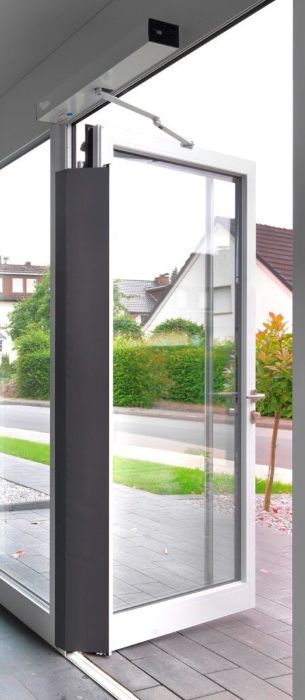
How Fingerguards Enhance Safety
- Eliminates danger Points:
As persons will pass through the door, it is possible to place your finger / hand into this area so the risk should be removed ideally to the full height of the door but to a minimum of 2mts.
Traditionally the door leaf design and how they are hung is by a hinge or pivot creating the risk and also the most common automatic door is to adapt or convert an existing door.
There are many products to allow you to do this without the need to replace the whole door system.
There are some door systems which through design do not create this risk as there is no significant gap and the door is curved.
- Improved Compliance:
Fingerguard systems are designed to comply with safety standards, such as BS EN 16005, which sets out safety requirements for automatic swing doors
Extracts from EN16005 2023 –
Power operated pedestrian doorsets shall be designed so that hazards due to crushing, shearing, impact and drawing-in during the opening and closing cycles are avoided or so that safeguards against such hazards are provided.
Danger points shall be safeguarded up to a height of 2,5 m above the floor with the following exception:
1. b) danger points between the leaf and frame presenting a fingertrap hazard can be protected up to only 2 m.
The following may be used:
• ⎯ guards (see 4.6.9);
• ⎯ limitation of leaf forces (does not apply to shearing and drawing-in hazards) (see 4.6.7);
• ⎯ electro-sensitive protective equipment (ESPE) and/or pressure sensitive protective equipment (PSPE) (see 4.6.8);
• ⎯ safety distances (see 4.6.11);
It also states:
Danger points between the leaf and frame presenting a finger trap hazard shall be avoided structurally or by an appropriate protective device or safeguards provided by means of protective measures
Conclusion
AT BH Doors, we naturally carry out dynamic risk assessments as part of our schedule of works to form part of our Service Contract Agreement.
Although any risk assessment checklist maybe subjective or open to personal interpretation our engineers are Doorsafe registered and we are members of the Automatic Door Installation Association (ADIA).
This will ensure we are working to the best practice within the industry, applying the relevant standards and regulations to all automatic doors we work upon for our customers.