

Are you compliant?
Commercial doors are not the type of product you can simply “fit and forget”.
Routine maintenance of doors and door sets in commercial buildings is essential and part of formal legislation for health and safety. Depending on the type of door there are differing maintenance and safety checks that need to be carried out relevant to aluminium commercial doors, automatic doors and fire exits.
Door Maintenance
There are many responsibilities imposed on building owners relating to doors whether they are manual, automatic or fire escapes.
We often take our doors for granted. It is common in public buildings or the workplace, to find ourselves putting up with doors that are simply not functioning correctly. Whether a door is slamming, sticking, failing to shut fully, failing to lock or other seemingly small problem might seem acceptable.
Most door issues can be avoided with simple routine maintenance. Virtually all hardware supplied with commercial doors have maintenance instructions supplied, whether this is for the door closer or for the lock.
The correct maintenance on manual entry and exit doors will provide solutions to small problems, but when these small problems affect doors designed to perform correctly in the event of an emergency, the consequences could be more severe.
The critical component on a manual door will invariably be the door closer and the way the door is hinged – whether this is on a concealed overhead door closer with threshold pivot or a face fixed closer and hinges.
A door closer must have an opening below 30N between 0 degrees and 15 degrees as required by BS8300 and current Building Regulations.
In high traffic buildings, simple routine maintenance of the door closing mechanism will probably ensure the entire door functions correctly, meet the fire exit requirements and make their overall use easier.
Additionally, failure to maintain door closers correctly can adversely affect the closing forces stated above and hinder the ability of users.
Dynamic risk assessments and industry standards
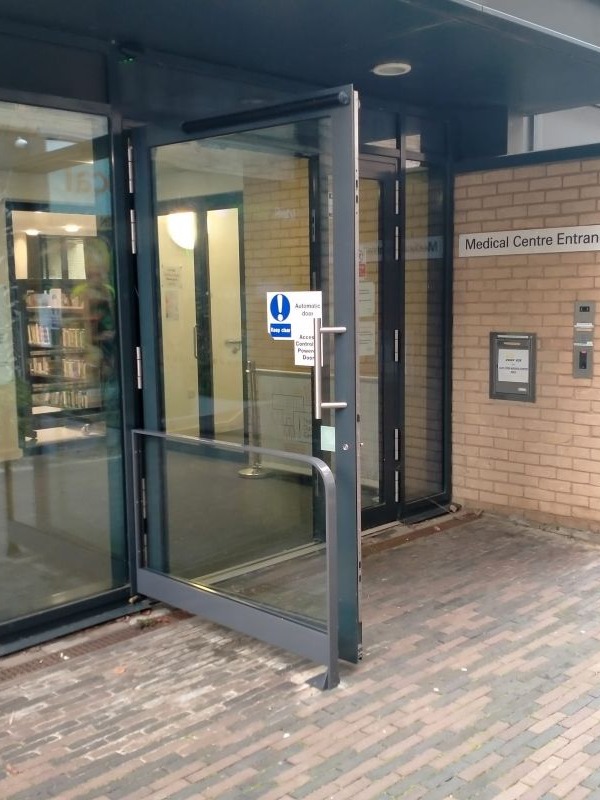
For automatic doors one of the key factors is risk, there are 4, impact, crushing, shearing and drawing in.
During a service we carry out a dynamic risk assessment which will take into account the door type, operational use, the users and carry out the necessary safety checks.
At any point that a risk has been identified, we will either try to eliminate it or reduce the risk to a safe level.
It may result in the automatic door system being adjusted, repaired or even switched off, but generally we will provide a quotation which will detail how to overcome the risk.
The customer will be informed via our risk assessment checklist document per door for their records.
The most common found risks are within the opening and closing cycles of automatic doors which result in pocket doors, barriers or fingerguards being recommended.
You can download our guides for everything you need to know here:
Automatic Doors
BS EN 16005 / BS7036-0 are the current standards applicable to automatic door sets and also requires servicing as well as carrying out the necessary risk assessments at least once a year.
All that needs to be done is to ensure that they are maintained in accordance with the instructions set by the manufacturer of the automatic power operator.
Most automatic door manufacturers specify annual service intervals but that will depend upon the type of building and the level of traffic.
Higher traffic automatic doors such as those used in hospitals, supermarket, airports and similar may require more frequent maintenance.


Fire Escapes
It is critical that these doorsets are always kept in optimum condition as generally fire exit doors are rarely or never used to enter or exit a building and are there only in the event of an emergency.
BS8300 and BS8214 states that manual fire exit doors should be examined twice a year with specific attention paid to panic bars, paddle handles, hinges, pivots and door closing mechanisms.
The above legislation covers the maintenance of fire exit doors but what you may not know is that each component of a fire exit door is also covered by its own standard. Closers and panic bars both have their own separate sets of British Standards BSEN1125 and 1154 that much be adhered to. Panic hardware of any sort should be inspected monthly and serviced twice a year to ensure their correct function and operation.
For further information regarding the standards please view BSI Group.
Emergency Repairs
- Fixed Call Out Fee
- Local Qualified Engineers
- Fast Response
- All Manufacturers Covered
- Common Spare Parts In Stock
Service & Maintenance
- Scheduled Service Visit
- Building Compliance
- Safety Risk Assessments
- Reduced Rates for Contract Customers
